

No-till Technology for Conservation Agriculture
ENTRY DATE: 17.04.2015 | LAST UPDATE: 17.04.2015
CATEGORIES:
- Agriculture
- Cropping techniques
TECHNOLOGIES MATURITY:
Applicable immediately
Technology Owners:
- The Cereals Systems Initiative for South Asia (CSISA) is mandated to increase farm productivity and smallholder income in South Asia through the accelerated development and deployment of new crop varieties and sustainable crop management technologies such as no-till.
- The project is being implemented by the CGIAR institutions the International Rice Research Institute (IRRI), the International Maize and Wheat Improvement Center (CIMMYT), the International Food Policy Research Institute (IFPRI) and the International Livestock Research Institute (ILRI).
Needs Address
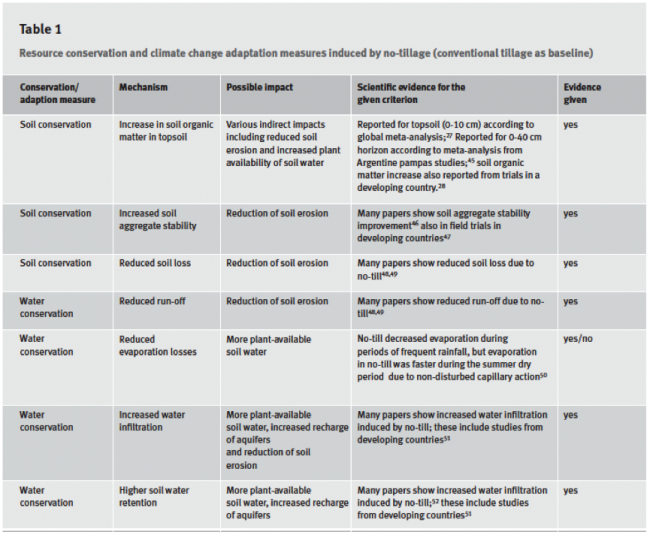
Conserves soil and water resources and reduces soil erosion
Adaptation effects
- The mulch layer minimizes evaporation for a certain period of time, and in regions of low rainfall this can conserve water and increase the water-use efficiency of the cultivated crops
- The permanent soil cover and low disturbance resulting from no-till also increases soil organic matter, at least in the top 10 cm of the soil, improving soil aggregate stability
- The significant soil- and water-conserving effect of no-till systems is regarded as a basis for higher and more stable crop yields
Overview and Features
Growing crops without disturbing the soil through tillage
Cost
- Equipment costs (manual tools to animal-powered devices and tractor-driven seeders, hoe or pointed stick)
- In many mixed farming systems, particularly in semi-arid areas where livestock are of significant importance, the costs of retaining crop residues as a mulch may be too great in relation to the potential benefits, which are often difficult to quantify
- Zero tillage wheat allows for a drastic reduction in tillage intensity with significant costs savings as well as potential wheat yield increases. The cost-saving effect alone makes zero tillage profitable and is the main driver behind its spread.
Energy source
Human labour
Ease of maintenance
It may require the introduction of regular pesticide application
Technology performance
Source: Gattinger, et. al. 2011.
Considerations
Requires knowhow and a detailed understanding of soil interactions
Co-benefit, suitability for developing countries
- Greenhouse gas (GHG) mitigation potential, including soil carbon sequestration, reduction of GHG emissions from soils, reduction of fossil fuel use, reduction of synthetic nitrogen fertilizer use
- Necessary economic input flexible to availability (see equipment costs)
- Accuracy of data is limited as only a few countries around the world conduct regular surveys on the use of no-till and conservation agriculture practices; likely to support industrialised agriculture techniques as it is used to justify the use of herbicides and herbicide-resistant GMOs. Therefore it runs counter to the shift towards environmentally sound organic agriculture.
- The effectiveness of no-till is fairly low for soil carbon sequestration and for the reduction of nitrous oxide (N2O) emissions from cultivated soils
- In manual cropping systems, land preparation and weeding are very labour intensive
- Limited in drought-prone areas
Information Resources
Clements, R., J. Haggar, A. Quezada, and J. Torres, 2011. Technologies for Climate Change Adaptation – Agriculture Sector. X. Zhu (Ed.). Roskilde: UNEP Risø Centre.
Erenstein, O. 2009. Adoption and Impact of Conservation Agriculture-based Resource Conserving Technologies in South Asia. Proceedings 4th World Congress on Conservation. Accessed from: http://www.fao.org/ag/ca/doc/wwcca-leadpapers.pdf#page=445 [02 November 2014]
Gattinger, A., Jawtusch, J., Muller, A. and Mäder, P. 2011. No-till Agriculture – a climate smart solution? Bischöfliches Hilfswerk MISEREOR e.v: Aachen, Germany. Accessed from: http://www.misereor.org/fileadmin/redaktion/No-till_really-climate-friendly_01.pdf [02 November 2014]
Kamboj, B.R., Kumar, A., Bishnoi, D.K., Singla, K., Kumar, V., Jat, M.L., Chaudhary, N., Jat, H.S., Gosain, D.K., Khippal, A., Garg, R., Lathwal, O.P., Goyal, S.P., Goyal, N.K., Yadav, A., Malik, D.S., Mishra, A. And Bhatia, R. 2012. Direct Seeded Rice Technology in Western Indo-Gangetic Plains of India: CSISA Experiences. CSISA, IRRI and CIMMYT. Available from: http://repository.cimmyt.org/xmlui/bitstream/handle/10883/1331/96764.pdf [02 November 2014]