

Wastewater treatment systems using membrane bioreactors (MBR) for separation of activated sludge
ENTRY DATE: 23.04.2012 | LAST UPDATE: 23.04.2012
CATEGORIES:
- Water Resources
- Improvement of water quality
TECHNOLOGIES MATURITY:
At the stage of introduction to being applicable immediately
Technology Owners:
Private sector companies (environmental equipment), etc.
Needs Address
The need reduce the impacts of worsening water quality of public waters (particularly in enclosed water bodies, etc.) as a result of climate change, in areas that may face worsening sanitation conditions.
Adaptation effects
・ Suppression of the worsening of water quality in enclosed water bodies due to the effects of climate change, etc.,
・ Prevention of worsening of sanitation conditions and reduction of disease risk due to climate change
・ Improved wastewater treatment capacity to deal with extreme events
Overview and Features
| Immersion type integrated MBR system |
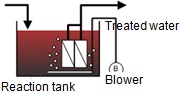 |
・ Most commonly adopted type ・ Process mechanisms are simple. ・ Cleaning of the air diffuser inside the reactor tank can be combined with the membrane module. By interconnecting and making multiple installations of membrane modules with other systems, it is possible to conduct inspections, repairs, and replacements of membrane modules without halting operation of the reactor tank. |
| Immersion type separate tank MBR system |
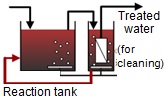 |
・ This configuration makes it easy to use as the required air diffusers can be used for biological treatment or backwash (can select gentle aeration or strong aeration).
・ Can operate the reactor tank with lower MLSS than MLSS in membrane tank.
・ By interconnecting and making multiple installations of membrane modules with other systems, it is possible to conduct inspections, repairs, and replacements of membrane modules without halting operation of the reactor tank.
・ More energy is required due to the need for sludge circulation pumps.
・ Construction costs are higher than for integrated unit.
・ Immersion cleaning is easy to do (it is possible to use the separate membrane tank as a cleaning solution tank).
|
| External tank type system |
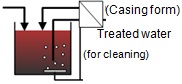 |
・ This configuration allows the greatest membrane flux (permitting a reduction in the number of membrane modules).
・ It has the greatest response to changes over time.
・ It is easy to control sludge circulation, etc.
・ By interconnecting and making multiple installations of membrane modules with other systems, it is possible to conduct inspections, repairs, and replacements of membrane modules without halting operation of the reactor tank.
・ More energy is required due to the need for sludge circulation pumps.
・ Cleaning with chemical cleaners is easy.
|
Note: The features (positive/negative) indicated in the table can vary with actual configuration, depending on such factors as design improvements, technology development, and changes in operational practices, etc.
Cost
・The figure below shows membrane cost trends in the European Union since the 1990s. Membrane costs declined by a factor of five in the ten years from 1994 to 2004 (from about 300 to about 60 euro/m2).
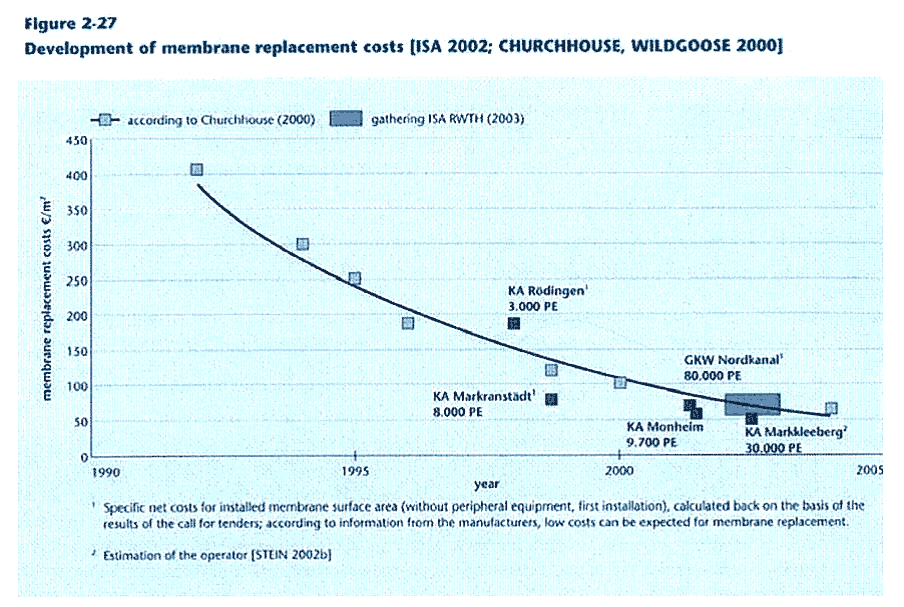
Membrane cost trends in the European Union
・MBR technology is still improving with R&D, and in the future costs of this technology are expected to decline as the market expands.
Energy source
Electricity
Ease of maintenance
Even after technical transfer (to developing country), there is a need for technology and technicians to perform operations and maintenance.
Considerations
・ Costs are high for such things as membrane maintenance and replacement, and electricity consumption to power blowers.
・ A stable supply of electricity is required.
・ Even after technical transfer (to developing country), there is a need for technology and technicians to perform operations and maintenance.
Co-benefit, suitability for developing countries
・ Improvement of sanitation by proper treatment of domestic wastewater.
Information Resources
・ "Guidelines for installation of membrane bioreactor technology for wastewater treatment (second edition)," March 2011, Technology Conference on Wastewater Treatment with Membrane Bioreactors (in Japanese).