

Stacking of large weather-resistant sandbags (for emergency response and restoration)
ENTRY DATE: 24.12.2014 | LAST UPDATE: 24.12.2014
CATEGORIES:
- Disaster Prevention
- Applicable to any disaster (Hard measures)
TECHNOLOGIES MATURITY:
Applicable immediately (high level of technological maturity, with a manual for disaster response and restoration already published – by the Public Works Research Center, 2012, in Japanese).
Technology Owners:
Public Works Research Center, Japan
Needs Address
The need for emergency response and restoration after a disaster in a river basin, including erosion and flooding due to heavy rain, etc.
Adaptation effects
Currently this method is limited to disaster emergency response and restoration, but other uses being considered include basic restoration and reinforcement/restoration (to strengthen capacity before a disaster).
Overview and Features
- Sandbags are cloth bags filled with sand, and are used as a convenient way to block the movement of water and sediment. A layered structure created by stacking sandbags maintains stability and can hold back the flow of water and other fluids.
- Because large weather-resistant sandbags are larger in size and more weather-resistant (they are less likely to be deformed, discolored, or to deteriorate due to changes in outdoor natural environmental conditions such as temperature, sunlight, humidity, rain, etc.) compared to commonly-used, conventional, sandbags. Thus, they are practical for installation, and can also reduce costs.
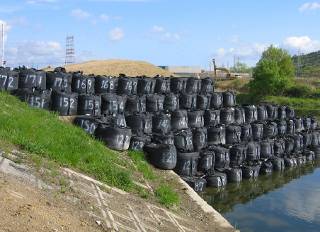
Photo: Weather-resistant large sandbags
Source: “Design and installation manual for the stacking method of large weather-resistant sandbags,” Public Works Research Center (2012) (in Japanese).
Cost
Costs are as follows.
Table: Price of Seaton Bags – Large weather-resistant sandbags
|
Stock item |
1-year life |
3-year life |
|
Material |
Polypropylene |
|
|
Size (mm) |
φ1100×H1100 |
|
|
Volume (m3) |
1.0 |
|
|
Price (yen) |
4,800 |
6,700 |
(http://www.netis.mlit.go.jp/NetisRev/Search/NtDetail1.asp?REG_NO=KT-060144)
Ease of maintenance
Because the use is limited to disaster emergency response or restoration, maintenance and replacement is easy.
Technology performance
Because the use is limited to disaster emergency response or restoration, it is necessary to review the performance within about three years. It is possible to further develop the technology for these restorations by improving these points to enhance specifications.
Considerations
Because the use is limited to disaster emergency response or restoration, there is room for improvement in order to use the sandbags for main restoration and reinforcement (strengthening capabilities before a disaster). The Public Works Research Institute (under Ministry of Land, Infrastructure, Transport and Tourism) is currently studying ways to improve on these points and improve specifications.
Co-benefit, suitability for developing countries
By being larger in size and more weather-resistant than conventional sandbags, these ones can be installed more easily and at lower cost, so they have a good cost-benefit ratio, and can be used appropriately in developing countries.
Information Resources
- “Stacking method of large weather-resistant sandbags: Design and installation manual,” Public Works Research Center (2012) (in Japanese).
- Haruki Horiuchi, Toshimi Tatsui, Kimitoshi Ryokai. Stacking method of large weather-resistant sandbags: Design and installation manual. Civil Engineering Journal 150-1, 1-4, 2008 (in Japanese).
- New Technology Information System (NETIS)
http://www.netis.mlit.go.jp/NetisRev/Search/NtDetail1.asp?REG_NO=KT-060144 (in Japanese) - Information for large sandbags installation for emergency response at the mouth of former Kitakami River.
http://www.thr.mlit.go.jp/bumon/kisya/kisyah/images/36017_1.pdf(in Japanese) - For inundation damage reduction at the lower the coastal Sendai Gulf
http://www.thr.mlit.go.jp/bumon/b00037/k00290/river-hp/kasen/110530-1.pdf (in Japanese)