

Rainwater use facilities
ENTRY DATE: 19.11.2013 | LAST UPDATE: 19.11.2013
CATEGORIES:
- Water Resources
- Rainwater use
TECHNOLOGIES MATURITY:
Applicable immediately
Technology Owners:
Each manufacturer. For reference, please see members' list on the website of the Association for Rainwater Storage and Infiltration Technology (in Japanese only). http://www.arsit.or.jp/
Needs Address
The need to temporarily compensate for water shortages arising from changes in rainfall patterns due to climate change.
Adaptation effects
Elimination or mitigation of water shortages due to climate change and other factors.
Overview and Features
Storage facilities for rainwater harvesting can store rain that falls nearby, for supplying a portion of the domestic water demands, such as tree watering, car washing, and toilet flushing. Locations for installation are unlimited, so the storage volume and uses can vary greatly depending on the size of these installations, from single-family homes to commercial facilities.
Major sites for consideration:
- Public facilities such as parks, schools, city hall, municipal offices, etc.
- Single-family homes, housing developments, high-rise residential buildings
- Large commercial facilities
Types:
- Rainwater storage tanks: Small tanks installed beside single-family homes, etc. An intake fitting is attached to roof gutter, directing rainwater into the tank for storage and use.
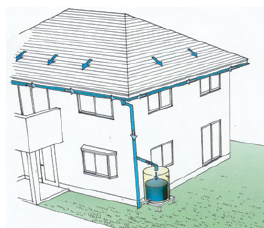
Figure. Example of a rainwater storage tank (home use)
(http://www.arsit.or.jp/)
- Underground type: The storage tank is made of concrete or other material, installed under underground for large commercial facilities and under the carport of single-family homes, etc.
- Use of a combined johkasou tank as rainwater storage tank: Use a johkasou (a community/household domestic wastewater treatment plant) as rainwater storage tank.
Additional Functions:
- ・ Besides the rainwater storage function, if the tank is not completely filled and allowed to have extra space, it can fulfill an additional function of reducing external runoff during intense rainfall if excess rain is directed into the tank.
- ・ If equipped with not only rainwater storage but also rainwater infiltration facilities (refer to information on technology for rainwater infiltration facilities), the facilities can fulfill a function of infiltration of excess rainfall into the ground.
Cost
Initial costs (tank for single-family home)
- Costs including material and installation are about 30,000 yen for a 200-liter tank and 100,000 yen for a one cubic meter tank.
Initial costs (small underground storage tank for single-family home use)
- Costs including material and installation average about 70,000 yen per cubic meter of storage. The cost breakdown, depending on material used, averages approximately 110,000 yen/m3 for concrete designs, 70,000 yen/m3 for plastic designs, and 60,000 yen/m3 for reservoirs made from crushed stone.
Subsidy programs:
- Some local governments in Japan offer related subsidy programs. Some of them subsidize about half of the cost of installing the storage facilities, up to a certain maximum amount. For example, Zama City in Kanagawa Prefecture offers a subsidy of 25,000 yen per rainwater storage tank.
- Besides what is mentioned above, legislation in Japan provides tax incentives, and low-interest financing is available from the Development Bank of Japan.
Energy source
For small underground storage for a single-family home: If an electric pump is used to deliver water for toilet flushing, the electricity cost would be about 6,000 yen per year.
Ease of maintenance
Storage tank for a single-family home: Space requirement is very small, and installation is relatively easy. Maintenance is easier if a filter is used to prevent debris from entering the tank, and if a drain is installed in the tank to permit the clearing of sludge.
Technology performance
Rainwater storage tanks for single-family homes: Most popular are tanks of about 200 liters in capacity, but 1000-liter tanks are also available. If the water is used for toilet flushing, the tank can meet water needs for about one to three days (approximated at 160 liters per day for a four-person household)
Considerations
- Technicians from consulting and construction firms are required at the design and construction phases.
- An electrical supply and electricity costs are required if the rainwater is to be pumped by electric pump.
Co-benefit, suitability for developing countries
- The storage and utilization of rainwater was once relatively common in developing countries, but urbanization has favored the use of flush toilets as municipal water piping has become available in new housing developments, so the use of rainwater has become less common. As a result, water demand has risen with urbanization and rising standards of living, meaning that in the event of water shortages, rainwater cannot be used as it was in the past, and in some cases it is not possible to secure enough water. In such cases, rainwater use can be important as a temporary backup.
- Tanks for single-family homes can be installed even in areas where no major facilities exist, so this technology has the potential to be applied in large areas of developing countries. Another benefit is that if installed for household, the tank can be convenient by reducing the need to go far to obtain water.
Information Resources
- Association for Rainwater Storage and Infiltration Technology
Introduces a variety of rainwater storage and infiltration designs. - Association for Rainwater Storage and Infiltration Technology
Installation Manual for Rainwater Harvesting and Infiltration Facilities in Single-Family Dwellings (in Japanese) - Sumida Ward (Rainwater Harvesting)
http://www.city.sumida.lg.jp/sumida_info/kankyou_hozen/amamizu/zyoseikin/zyoseigaku_itiran.html - Zama City
http://www.city.zama.kanagawa.jp/www/contents/1190789604474/index.html - Star City (Korea)
Rainwater Harvesting System as an Adaptation Strategy to Climate Extremes (Moo Young Han)
Source Water Management in Droughts (Moo Young Han) - Suido Kiko Kaisha, Ltd. (Rainwater harvesting system at the Kokugikan)
http://www.suiki.co.jp/hensen/85_95/85_2.htm - Nihon Sumo Kyokai