

Measures to deal with soft ground: Reinforcing the ground using soil bags
ENTRY DATE: 23.04.2012 | LAST UPDATE: 23.04.2012
CATEGORIES:
- Coastal Regions
- Reinforcing facilities and structures
TECHNOLOGIES MATURITY:
Applicable immediately
Technology Owners:
・ Soil Bag Research Society (Hajime Matsuoka, Professor Emeritus, Nagoya Institute of Technology)
・ NPO Community Road Empowerment (CORE)
・ National Agriculture and Food Research Organization, National Institute for Rural Engineering (Kenichi Matsushima)
Needs Address
The need to reduce damage in regions that may be affected by sea level rise from climate change, by more intense storm surges from climate change, and by inundation due to tropical cyclones, etc.
Adaptation effects
These technologies (reinforcement of house foundations, material for backfill of retaining walls, reinforced soil walls, foundations for retaining walls, road repair/maintenance, disaster recovery construction, etc.) can be used in a variety of areas. They offer benefits of protection from damage from a variety of disasters caused by the impacts of climate change, and can help speed recovery after disasters.
Overview and Features
・By completely enclosing soil and restraining it, the interparticle force increases dramatically, and the interparticle friction also increases, thereby significantly increasing the load-bearing strength.
・ These characteristics can be utilized in a variety of areas, such as reinforcement of house foundations, material for backfill of retaining walls, reinforced soil walls, foundations for retaining walls, road repair/maintenance, disaster recovery construction, etc.
・Because construction costs are low, and most materials can be procured locally, these technologies can be easily adopted in developing countries.
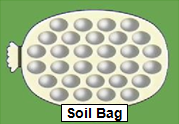 1. Put sand, crushed stones, etc., into soil bag |
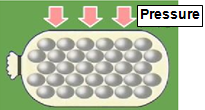 2. Apply pressure from above and soil bag becomes flatter |
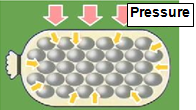 3. If the soil bag becomes flatter, the circumference increases and the bag gets tighter. |
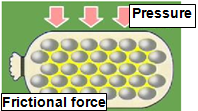 4. If the bag gets tighter, the interparticle tension of the soil particles inside the bag increases, and frictional force also increases. |
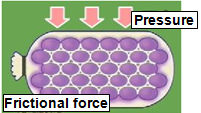 5. Due to greater frictional force between the soil particles, the soil bag itself becomes more constrained, to the point that it becomes about as strong as concrete. |
Mechanism of hardness strengthening of soil bags
Source: http://www.soilbag.com/theory.htm (in Japanese)
Cost
Example of application for roads in Kenya
Road improvements at Nyabomo Farm
|
Item |
Unit price (JPY) |
Volume |
Cost (JPY) |
% |
|
Soil bag |
21 (per bag) |
1,472 |
30,912 |
65.9 |
|
Sisal rope |
270 (per bundle) |
2 |
540 |
1.2 |
|
Malam soil |
225 (per ton) |
58 |
13,050 |
27.8 |
|
Transportation cost |
|
|
2,400 |
5.1 |
|
Total |
|
|
46,902 |
100.0 |
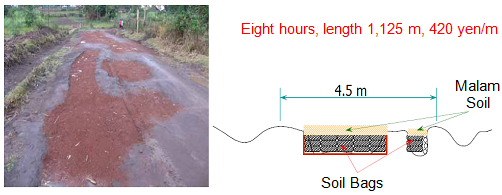
Source: http://www.michibushinbito.ecnet.jp
Ease of maintenance
These strategies require access to experts knowledgeable about soil bags.
Technology performance
Technology performance vary significantly depending on the type and size of facility.
Considerations
These strategies require access to experts knowledgeable about soil bags.
Co-benefit, suitability for developing countries
・ These technologies are also linked with measures to deal with soft ground, and with vibration, etc.
・ Because construction costs are low, and most materials can be procured locally, these technologies can be relatively easily adopted in developing countries.
Information Resources
・ Pilot test on wave erosion countermeasures for rural roads in Bangladesh, Mori et. al, JGIGS 2011 Vol. 27, No. 1, 27–36 (in Japanese).
・ A New Earth Reinforcement Method using Soilbags, 2006, Hajime Matsuoka, Sihong Liu
・ SoilBAG (high performance soil bag construction methods) http://www.soilbag.com/ (in Japanese)