

Desalinisation technology
ENTRY DATE: 26.04.2012 | LAST UPDATE: 26.04.2012
CATEGORIES:
- Water Resources
- Water supply measures
TECHNOLOGIES MATURITY:
Applicable immediately (tens of desalination plants are already in operation in Japan)
Technology Owners:
Several manufacturers, etc.
Needs Address
The need to reduce the impacts of drought in areas that may experience drought due to climate change. The needs are particularly high on small islands and other places that have limited freshwater resources.
Adaptation effects
Securing water resources to deal with drought resulting from climate change
Overview and Features
・There are three methods of desalination:
√ Evaporation: A method to obtain fresh water by condensation of vapor made by evaporation of seawater.
√ Reverse osmosis: A method to obtain fresh water by filtering seawater under pressure using a semi-permeable membrane through which seawater cannot pass.
√ Electrodialysis: A method to obtain fresh water using a special membrane that can separate seawater into diluate and concentrate, and then extract freshwater from the diluate. This is at an experimental research stage.
Desalination plants are being introduced in the Middle East and Mediterranean region, and the reverse osmosis method in particular is spreading rapidly.
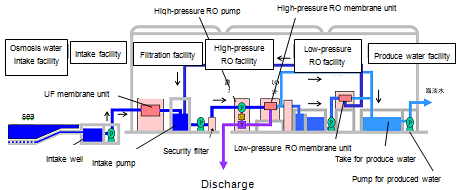
Reverse osmosis desalination system
Source: Fukuoka District Waterworks Agency
Cost
・Hybrid systems that use both evaporation and reverse osmosis have attracted much attention recently due to low costs, now below US$0.5/m3 of fresh water produced. On the other hand, high oil prices and tight supplies of metal can increase operating and construction costs, so it may be difficult to keep the cost of water production low in the future.
Shuqaiq Water Production Project, Saudi Arabia (completed 2010)
・An 850,000 kW power plant and 178,000 m3/day seawater-to-freshwater facilities were newly constructed in Shuqaiq (a city near the Yemen border on the Red Sea side), and in 2010 started supplying Saudi Power and Water Company under a twenty-year contract.
・Total project cost: About 2 billion dollars
Mesaido Industrial District Power and Water Project Water Production Project, Qatar (completed 2010)
・This was a new construction of a 2,000 MW power plant in the Mesaido Industrial District near Doha in Qatar.
・Total project cost: About 2.3 billion dollars
Considerations
・ Key issues for the spread of these technologies include reducing the cost of producing fresh water, stabilizing plant performance, and establishing easy procedures for plant operation, maintenance and management.
Co-benefit, suitability for developing countries
・ By securing new water resources, these technologies can make it possible to provide a stable supply of water for households and industry.
Information Resources
・Kyowakiden Industry (English)
http://www.kyowa-kk.co.jp/english/index.html
・Fukuoka District Waterworks Agency (English)
http://www.f-suiki.or.jp/english/index.php
・Science Portal China (Japanese) (article by Mitsuyoshi Hirai, Water Reuse Promotion Center)
http://www.spc.jst.go.jp/hottopics/0907water/r0907_hirai.html
・JICA project information: Maintenance of electrical and piping systems for seawater desalinization equipment (English version available)
http://gwweb.jica.go.jp/km/ProjectView.nsf/4f3700b697729bb649256bf300087d02/49a77086f6a54b6e492577e50079ddce?OpenDocument