

Coastal protection with built structures
ENTRY DATE: 19.04.2012 | LAST UPDATE: 19.04.2012
CATEGORIES:
- Coastal Regions
- Improvement of structures
TECHNOLOGIES MATURITY:
Applicable immediately
Technology Owners:
・Consultants, construction firms
・Local governments
Needs Address
The need to reduce damage in regions that may be affected by sea level rise from climate change, by more intense storm surges from climate change, and by inundation due to tropical cyclones, etc.
Adaptation effects
It is possible to protect human life and property inland, from coastal disasters caused by storm surges, and waves, etc. In areas with particular concentration of population and property, the defense of built structures is particularly appropriate.
Overview and Features
・ The construction of various types of built structures in coastal zones protects human life and property located inland from coastal disasters caused by storm surges, and waves, etc.
・ The options can generally be put into the following categories based on their function and form: embankments, shore protection, detached breakwaters, submerged breakwaters, jetties/groynes, beach nourishment, and flood gates, sluice gates or land locks, etc. It is important to decide on the optimal combination of these options for coastal protection methodologies based on consideration of factors such as the local community conditions, natural conditions, coastal uses, and scenery, etc.
・ In Japan the national government has established the Basic Policy for Coastal Conservation. Based on these policies, prefectures establish coastal protection basic plans for each coastline in response to local conditions, while reflecting local opinion. Based on similar topography and hydrographic conditions, and on continuity of coastal sand drift, the Basic Policy for Coastal Conservation establishes 71 coastlines nationwide for basic plans to be established.
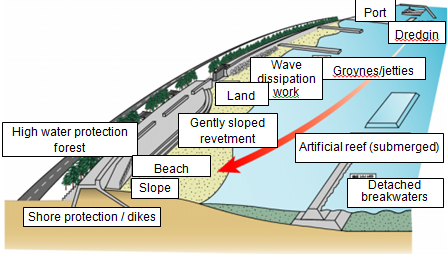
| Type of coastal protection facility/structure | General description | Illustration |
|
Dikes |
Structures that raise the level of the ground using a soil embankment or placement of concrete to prevent the incursion of seawater from storm surges and tsunamis, to reduce wave overtopping, and to prevent land erosion. |
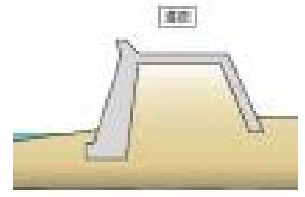 |
|
Shore protection |
Structures that cover the ground using rocks or concrete, etc. to prevent the incursion of seawater from storm surges and tsunamis, to reduce wave overtopping, and to prevent land erosion. |
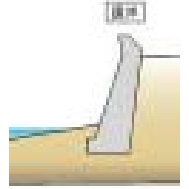 |
|
Gently sloped revetment |
A type of shore protection that features gentler slopes in order to permit access to the beach and human interaction with the water. |
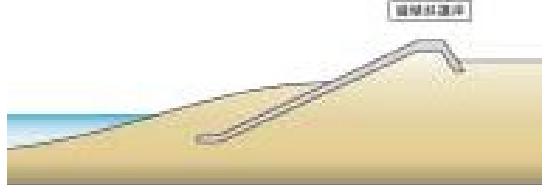 |
|
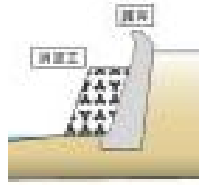
Wave dissipation work |
Facilities installed in front of shore protection, in order to reduce the occurrence and force of overtopping waves, and to reduce impact of wave pressure. |
 |
|
Groynes/jetties |
Facilities built to jut directly out from the shore where there is considerable sand movement (drift) parallel to the coastline, in order to maintain the shoreline (or promote its advance) by controlling the sand drift. |
 |
|
Detached breakwaters |
Facilities built offshore roughly parallel to the shoreline, with the purpose of reducing the size of arriving waves, and to build up sand on the inshore side, prevent erosion, and form beaches. |
 |
|
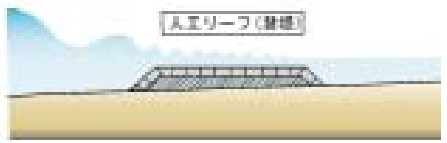
Artificial reef (submerged) |
These structures mimic the wave attenuation effect of coral reefs and have similar purpose and effects to detached breakwaters, but are submerged due to consideration of ocean views and scenery. |
 |
|
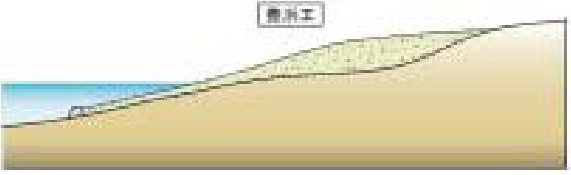
Beach nourishment |
By supplying sand artificially to beaches that have been eroded, these facilities have the purpose of reducing coastal erosion and wave overtopping, and to form swimming beaches, etc. |
 |
|
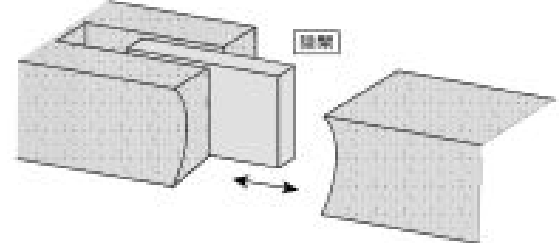
Land lock |
Gates that allow the passage of vehicles and people and are installed in front of embankments and parapet walls for use at beaches, ports, and fishing harbors, etc. |
 |
Cost
Costs vary significantly depending on the type and size of facility.
Ease of maintenance
Ease of maintenance vary significantly depending on the type and size of facility.
Technology performance
Technology performance vary significantly depending on the type and size of facility.
Considerations
・These strategies require access to experts with a high level of knowledge about coastal protection planning and facilities design.
・It is important to give technical consideration to the special characteristics of each coastline.
・When considering how to improve the coastline, in implementation of these strategies, it is important to seek consensus with local communities and other stakeholders, as well as cooperation with other operations and administrators.
Co-benefit, suitability for developing countries
Ensuring that areas are physically protected from natural disasters contributes significantly to sustainable development.
Information Resources
Tokyo Metropolitan Governmnet (Coastal Conservation Facilities Plan)
http://www.kouwan.metro.tokyo.jp/jigyo/kaigan-plan/index.html