

Ecological Pest Management/ Integrated Pest Management
ENTRY DATE: 17.04.2015 | LAST UPDATE: 17.04.2015
CATEGORIES:
- Agriculture
- Sustainable crop management
TECHNOLOGIES MATURITY:
Applicable immediately
Technology Owners:
FAO have been the main implementers of integrated pest management systems
Needs Address
- Reduced crop damage from pests
- Food security
- Strengthening of biological diversity
- Stabilise agricultural production
Adaptation effects
- Reinforces natural pest regulation processes
- Improves agricultural production
- Sustainable agricultural development
- Provides a healthy and balanced ecosystem in which the vulnerability of plants to pests and diseases is decreased
- Builds farmers’ resilience to potential risks posed by damage to crop yields caused by newly emerging pests and disease
Overview and Features
Ecologically-based pest management that increases the biodiversity of the agro-ecological system, reducing the density of the pest population through integrated crop, soil and pest management
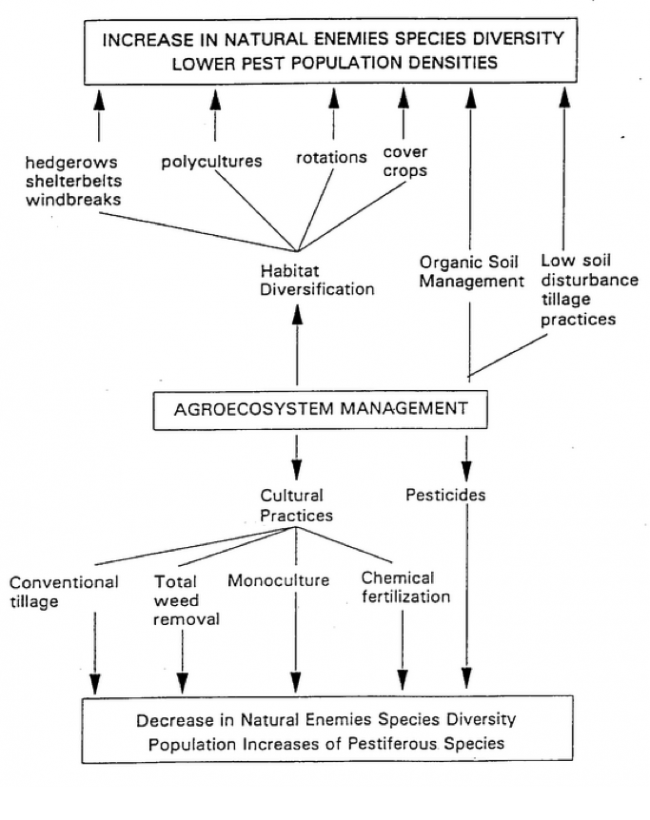
Figure: The effects of agro ecosystem management and associated cultural practices on the biodiversity of natural enemies and the abundance of insect pests (Source: Altieri and Nicholls, n.d.)
Cost
- Reduced costs compared to non-organic approaches
- Training costs
Energy source
Average of 30 per cent less fossil fuel energy than non-organic methods
Ease of maintenance
Very strong pests for which a biological controller has not been identified, encouraging conversion back to chemical pesticides by farmers
Technology performance
- Naturally and sustainably decreases pest damage, however though a controller may work well in one soil type, it may not work at all in another soil type. In the long run, more than one type of biological controller may have to be used to achieve uniform control across a variety of different situations and land types
- Quick fix not possible as biological controllers take several years to establish a population and begin making a significant contribution. In addition, no single biological controller works in every situation
Considerations
- Requires substantial knowledge and monitoring
- Knowledge is required on (i) pests and their natural enemies, (ii) effective and economic means of producing natural enemies, (iii) interactions between different means of pest control
- Information on the various technological options that may be used to deal with pests and diseases is also required for the implementation of this technology.
- Need institutional structures that enable farmers to organise themselves so as to jointly implement the proposed solutions
Co-benefit, suitability for developing countries
- Sustainable ecological management
- Reduced costs of pesticides, fuel, equipment and labour for farmers
- Can increase production levels
- Challenges in knowledge accessibility
- Economic challenges found in competing simplicity and apparent efficacy of chemicals; lower prices for ecological pest management-produced goods; high cost of selective pesticides; lack of fiscal policy that favours ecological pest management over pesticide use; high perceived risk if spraying is not carried out; failure to consider long-term advantages
- Socio-cultural barriers: a major obstacle to the implementation of this technology is that farmers generally prefer commercial pesticides because they are easier to apply and manage
Information Resources
Altieri, M.A. and Nicholls, C.I. n.d. Ecologically based pest management: a key pathway to achieving agro ecosystem health. Available from: http://www.unicamp.br/fea/ortega/agroecol/ecpestma.htm [14 November 2014]
ClimateTechWiki, n.d. Ecological Pest Management. Available from: http://www.climatetechwiki.org/content/ecological-pest-management [14 November 2014]