

Subsurface dams
ENTRY DATE: 24.04.2012 | LAST UPDATE: 24.04.2012
CATEGORIES:
- Water Resources
- Prevention measures for salt water intrusion of groundwater
TECHNOLOGIES MATURITY:
Ready for introduction, to be applied immediately
Technology Owners:
・ Rural Development Bureau Ministry of Agriculture, Forestry and Fisheries of Japan
・ Agriculture, Forestry and Fisheries Department, Okinawa General Bureau, Cabinet Office, Government of Japan
Needs Address
The need to reduce the impacts of drought as a result of climate change, and increased salinity of groundwater and so on due to sea level rise, in areas that may experience those problems. The needs are particularly high on small islands and other places that have limited freshwater resources.
Adaptation effects
・ The benefits of measures to secure water resources in the face of drought caused by climate change
・ The benefits of preventing increased groundwater salinity due to sea level rise caused by climate change
Overview and Features
・ Subsurface dams create a wall past which water in the ground cannot pass, and serve as structures to collect water by blocking the flow of groundwater. There are two functions of subsurface dams.
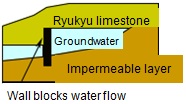
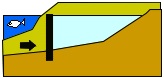
dam-up type underground dam (left), salt water obstruction type underground dam (right)
Cost
・ Because costs vary with factors such as geographical features and depth of excavation, detailed studies are necessary in order to determine costs.
Ease of maintenance
Management subjects of subsurface dams are listed as below.
|
Management subjects |
Purpose and contents of the management |
Management method |
|
|
Facility management |
Cut-off wall management |
Measuring the leaking from cut-off walls. Measuring the leaking from damaged cut-off walls. |
Monitoring the groundwater level of the upper down stream in cut-off walls. |
|
Intake facility management |
Function maintenance for intake facilities and updating the facilities. |
Measuring the water level deposition during intaking, etc. |
|
|
Drainage facility management |
Function maintenance for drainage facilities and updating the facilities. |
Monitoring the pondage level. Measuring the drainage amount, etc. |
|
|
Other facilities management |
Function maintenance for aquifer charging facilities and other management facilities. |
|
|
|
Reservoir control |
Intake control |
Measuring the pondage level (reservoir amount). Performing the best optimum allocation of intake amount in the intake facilities and operating the facility optimally. |
Monitoring the pondage level. Measuring the amount of intake water. Operating intake facilities, etc. |
|
Drainage control |
Measuring the pondage level when it's downpour. Performing the appropriate drainage such as deciding the best time to start drainage and appropriate amount when it's downpour. |
Monitoring the pondage level. Operating the drainage facilities etc. |
|
| Water quality control |
Maintenance of reservoir water quality control for the purpose. Comprehending the salt water invasion situation. Performing the appropriate desalination from the reservoir. |
Monitoring the water quality in the pondage area. Water quality conservation measures in the water catchment area. Operating the desalination facilities, etc. |
|
Source: Technical Reference for Effective Groundwater Development(March 2004)
Considerations
・Where the water is to be used for agricultural purposes, it is necessary to construct other facilities together, such as water intake facilities, canals and channels, etc.
・Because costs vary with factors such as geographical and geological features where this technology can be applied, detailed studies are necessary to determine costs.
・When constructing a subsurface dam, one condition is local access to the required specialized equipment.
Note: In Japan the main method being used to excavate for construction of subsurface dams is the "soil mixing wall" (SMW), which uses a specially –developed multi-axis mixing auger that drills into the ground, and discharges a cement slurry from the tip as it drills each element, creating a soil-cement wall structure.
Co-benefit, suitability for developing countries
・ Constructing canals together with construction of subsurface dams can help to shift to more profitable crops while also reducing the work of water transport and supply, and also reduce damage from droughts and typhoon-driven tidal surges (whether or not related to climate change).
・ The current land use can continue on the ground (a particular benefit on small islands with limited land area.)
・ Benefits for arable land: Conversion to more profitable crops, more efficient canal operations, resilience to drought
・ Economic benefits from the promotion of agriculture
Information Resources
・ Website of Okinawa General Bureau, Cabinet Office, Government of Japan (in Japanese)
http://ogb.go.jp/nousui/nns/c2/page1-1.htm