

Provision of real time information; forecasting, warning and early warning systems
ENTRY DATE: 18.04.2012 | LAST UPDATE: 18.04.2012
CATEGORIES:
- Coastal Regions
- Observation systems, information dissemination
TECHNOLOGIES MATURITY:
Applicable immediately
Technology Owners:
Japan Meteorological Agency; Fire and Disaster Management Agency; Ministry of Land, Infrastructure, Transport and Tourism
Needs Address
The need to reduce damage in regions that face greater risks from more intense tropical cyclones and storm surges, etc., due to climate change and the resulting damage from inundation.
Adaptation effects
By the transmission of information in real time about disaster risks and by the appropriate actions of citizens who receive that information, vulnerability to climate change will be reduced, and in particular, human losses will be mitigated.
Overview and Features
・Meteorological, marine, and river conditions will be known in real time, and that information will be provided in a timely fashion. In addition, short-term projections will also be provided. Furthermore, in the event of concerns about the occurrence of disasters due to meteorological phenomena such as heavy rain and typhoons, advisories and warnings can be issued, and disaster management actions by the relevant bodies and local residents can be encouraged.
・ Examples of types of warnings include heavy rain warnings, flood warnings, storm warnings, high surf warnings, and storm surge warnings.
・Warnings are issued to areas where meteorological and other parameters (rainfall amount, wind speed, wave height, tide level, etc.) are expected to reach certain thresholds, considering observed and projected readings. These thresholds are determined depending on local conditions, based on research on the relationship between the occurrence of disasters and meteorological parameters.
・It is important to have in place some means of issuing information during disasters. Even in cases where the communications infrastructure has sustained damage, it is important to have in place means of ensuring that information can be communicated to residents, etc.
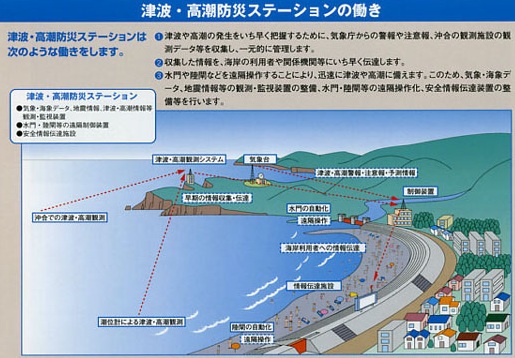
Possible arrangement of disaster management stations for tsunami and storm surges
Tsunami/storm surge disaster management stations
* Safety information communication equipment
Cost
・ Costs can vary significantly depending on the type of weather phenomenon, the scale of the observation system (e.g., national versus local/regional), the design of the projection/early warning system, and the communication mode, etc.
・ For reference, in the case of a warning system based on water level observations for river flooding and overflowing of inland water bodies (alert issued when waters reach a certain level), a rough estimate of costs would be about one million yen per site for measurement devices, and about 100 million yen per unit for centralized data processing equipment (excluding costs of communication lines, water level projections, etc.).
Considerations
・Other important aspects to consider include how to apply and increase accuracy of projections that take into account new phenomena relating to climate change; how to ensure responses in real time; and how to strengthen warning technologies based on diversification and acceleration of means of communication.
・ For those purposes, it is important to enhance observations of meteorological/water/land phenomena, to improve specialized institutional systems to share observational data with related organizations, and to conduct appropriate and efficient operations and capacity building.
・Regarding technology transfer, it important to choose forecasting and warning methods that are locally appropriate, and to use communications lines and information transmission methods that are diverse and locally appropriate. Other important issues include overall capacity building, including improving equipment for the data observation required for projection, forecasting and warning, and real-time data collection, projection, and communication, for every stage, from observation to the issuance of alerts.
・ In order for local residents and others to understand the forecast and warning information they receive and conduct themselves appropriately in a disaster, it is important to promote awareness, and conduct trainings and education on an ongoing basis during non-emergency times.
・ Where digital disaster radio/wireless communication is used, it is important to consider compliance with local radio communications regulations and the available frequency spectrum, etc.
Co-benefit, suitability for developing countries
・ It is possible to design systems on a scale and with the accuracy that matches objectives, depending on which phenomena are targeted.
・Besides applications for disaster management, these technologies can also provide basic information for river development plans and water utilization plans, etc.
・Even in areas where major infrastructure/physical measures cannot be immediately implemented due to cost or time constraints, etc., it may be possible to reduce damage.
Information Resources
・Real-time NOWPHAS (Ports and Harbours Bureau, Ministry of Land, Infrastructure, Transport and Tourism
http://www.mlit.go.jp/kowan/nowphas/ (in English and Japanese)
・Weather advisories and warnings (Japan Meteorological Agency): Heavy rain, flooding, snow, wind, blizzard, wave, storm surge, etc.
http://www.jma.go.jp/jp/warn/ (in Japanese)
・Typhoon information (Japan Meteorological Agency)
http://www.jma.go.jp/jma/kishou/know/typhoon/7-1.html (in Japanese)
・Flood predictions (Japan Meteorological Agency, and Ministry of Land, Infrastructure, Transport and Tourism or prefecture)
http://www.jma.go.jp/jma/kishou/know/bosai/flood.html (in Japanese)
・Tsunami advisories, warnings, information, forecasts (Japan Meteorological Agency)
http://www.seisvol.kishou.go.jp/eq/index_tsunamiinfo.html (in Japanese)
・Rainfall short-term forecasts, rainfall nowcasts
http://www.jma.go.jp/jma/kishou/know/kurashi/kotan_nowcast.html (in Japanese)
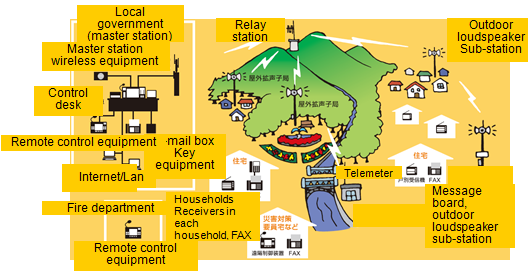
・Disaster administration wireless communication system
http://www.tele.soumu.go.jp/j/adm/system/trunk/disaster/index.htm (in Japanese)
http://www.fdma.go.jp/neuter/topics/jouhou/pdf/bousaimusen2011.pdf (in Japanese)
・Panel on Infrastructure Development (2008): Report on adaptation to changes in climate associated to global warming, with regard to water-related disasters.
http://www.mlit.go.jp/river/basic_info/jigyo_keikaku/gaiyou/kikouhendou/index.html (in Japanese)
・River Bureau Ministry of Land, Infrastructure, Transport and Tourism, Japan (2010): "Practical Guidelines on Strategic Climate Change Adaptation Planning – Flood Disasters – "
http://www.mlit.go.jp/river/basic_info/english/pdf/guigelines_eng.pdf